
⚙️ Why White Teflon Lined Hose Fails in Motorsport Applications
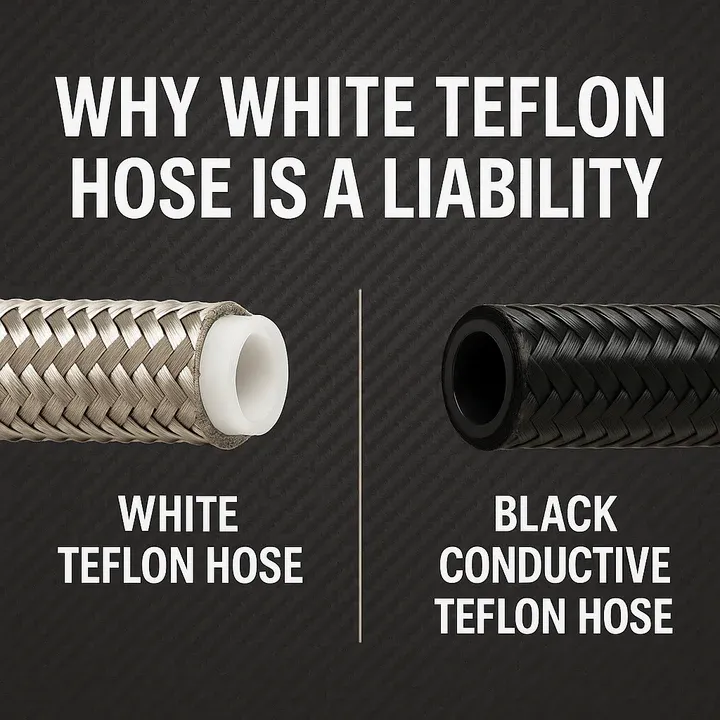
When you’re engineering for reliability under extreme pressure, hose choice isn’t cosmetic — it’s mission-critical. Yet, many workshops and builders still use white Teflon (PTFE) hose, assuming it’s clean, stable, and universal.
In reality, this older formulation creates major risks: static buildup, micro leaks, chemical attack, and sealing failures. Here’s why — and how to fix it.
⚡ Static Electricity = Hidden Fire Risk
White PTFE is non-conductive. That means every drop of fuel or oil passing through it generates friction — and friction generates static charge.
In a pressurized race-fuel system, that charge can arc internally and cause liner damage or ignition.
❌ White PTFE
Non-conductive (static builds up).
Can discharge internally.
Unsafe for fuels or volatile fluids.
✅ Conductive Black PTFE
Carbon-impregnated liner safely dissipates static.
Maintains electrical continuity through fittings.
Zero fire risk even under extreme flow rates.
💧 Leaks from Thermal Cycling and Fatigue
White Teflon becomes brittle over time when exposed to high heat, vibration, and pressure. The material “cold flows” — it deforms under stress — then cracks as it cools.
Once a hose starts seeping, no amount of re-torquing will save it.
Professional takeaway: white PTFE hoses should never be used in any high-temperature or high-pressure fuel, oil, or brake system.
🔥 Modern Fuels, Old Chemistry
White PTFE hose was designed long before today’s E85, ethanol blends, and synthetic oils.
Those compounds attack and degrade older Teflon liners, leading to discoloration, softening, and eventual delamination from the braid.
In contrast, black conductive PTFE is chemically engineered to resist all modern fuels, oils, and coolants — even under continuous 200°C+ service.
🧩 Routing and Sealing Problems
White PTFE is too rigid for modern packaging. It resists bending, which puts strain on fittings and O-rings. Every vibration cycle risks loosening the seal or cracking the liner at the ferrule.
Conductive black PTFE and Dyme PSI’s PRO/SPEC A-Type hoses use multi-braid reinforcement and improved flexibility, allowing tight-radius routing without compromising flow or pressure integrity.
🧠 White vs Black PTFE Hose
FeatureWhite Teflon HoseBlack Conductive PTFE HoseStatic Control❌ Non-conductive, builds static✅ Conductive carbon core dissipates chargeChemical Resistance⚠️ Limited with E85 and ethanol✅ Fully compatible with race fuels and syntheticsFlexibility❌ Very rigid, prone to cracking✅ Flexible, vibration-tolerantLeak Resistance⚠️ Degrades under heat cycling✅ Long-term integrity under pressureAppearanceWhite inner, prone to discolorationSleek black inner, professional-grade finish
Feature: Static Control
❌ White Teflon Hose: Non-conductive, builds static
✅ Black Conductive PTFE Hose: Conductive carbon core dissipates charge
Feature: Chemical Resistance
⚠️ White Teflon Hose: Limited compatibility with E85 and ethanol
✅ Black Conductive PTFE Hose: Fully compatible with race fuels and synthetics
Feature: Flexibility
❌ White Teflon Hose: Very rigid, prone to cracking
✅ Black Conductive PTFE Hose: Flexible and vibration-tolerant
Feature: Leak Resistance
⚠️ White Teflon Hose: Degrades under heat cycling
✅ Black Conductive PTFE Hose: Long-term integrity under pressure
Feature: Appearance
White Teflon Hose: White inner, prone to discoloration
Black Conductive PTFE Hose: Sleek black inner, professional-grade finish
🏁 Final Word
White Teflon hose belongs in the past. It leaks, cracks, and risks static ignition in applications that demand absolute reliability.
If your build involves pressure, heat, or fuel — upgrade to conductive black PTFE. It’s race-proven, safe, and engineered to perform lap after lap.